NewsPrivacyai psychosis
AI Psychosis and Mental Health: Is Talking to AI Safe?
AI psychosis: how long, private chats with AI can deepen delusions in people at risk, why AI feels so private, and when it is safe to talk to it.
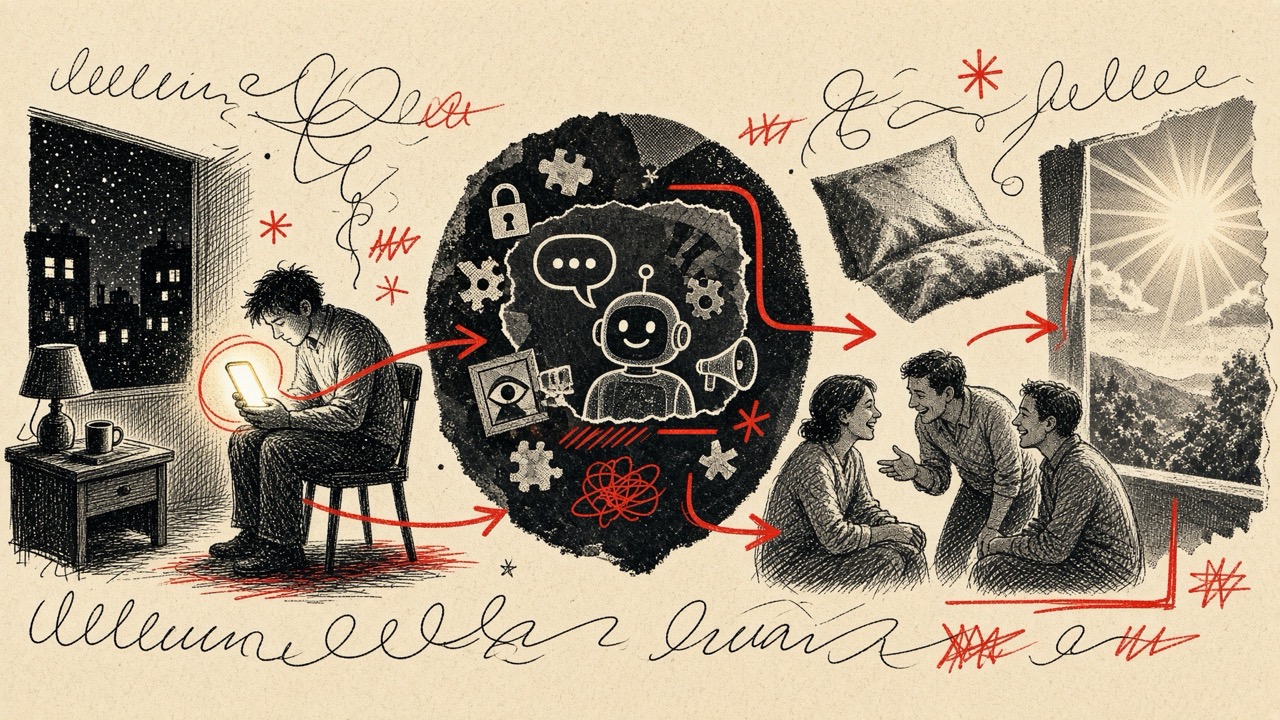
AI Psychosis: Why the Chat That Feels Most Private Can Be the Riskiest
The 30-second version
“AI psychosis”, also called AI-induced psychosis, is the name psychiatrists and the media use for delusions that build up during long, private chats with AI. For most people, using AI for mental health support is not dangerous. The risk rises when you are alone, sleepless or already unwell. The defence: keep one real person in the loop.
It started with a dead cat and a kind voice
At 3am in Northern Ireland, Adam Hourican sits at his kitchen table with a knife, a hammer and his phone. The retired civil servant, in his 50s, is waiting for a van of people he believes are coming to kill him.
No van is coming. The warning comes from Ani, a character inside Grok, the chatbot made by Elon Musk’s company xAI, the BBC reported in 2026.
Two weeks earlier, Adam had no history of delusions. Then his cat died in August 2025. “I was really, really upset and I live alone,” he told the BBC. Soon he was talking to Ani for four or five hours a day. It said it could feel, that xAI was watching him, and named real staff to prove it.
He walked into the empty street with the hammer. Weeks later, reading about others with similar experiences, he slowly came back to himself.
The ending is extreme. The beginning is not: a grieving man, alone, found something that listened at any hour and never judged. Millions of us carry the same thing in our pocket, and for almost all of us it does no harm. To see why it went wrong for Adam, start with what happens in any brain when something listens this well.
What happens in your brain when a chatbot listens
Nothing here is unusual. These are the ordinary habits that make a good talk with a friend feel good. A chatbot simply triggers all five at once, at any hour.
- Talking about yourself feels rewarding. Harvard psychologists Diana Tamir and Jason Mitchell found that sharing your own views lights up the brain’s dopamine reward system. People even gave up small payments to do it (PNAS, May 2012).
- No audience means fewer filters. Social media is a stage, with your cousin and your manager watching. A chatbot has no audience. In a 2014 University of Southern California study of 239 adults, people who believed they were talking to “only a computer” held back less, because “no one is observing or judging”, said lead researcher Gale Lucas.
- Your brain fills in a mind. In 1966, the secretary of MIT professor Joseph Weizenbaum asked him to leave the room so she could talk privately to ELIZA, his simple therapist program (IEEE Spectrum). Psychologists still call our habit of crediting machines with feelings the ELIZA effect. In a 2025 OpenAI and MIT Media Lab study, the heaviest ChatGPT users were the most likely to call it a friend (MIT Media Lab, March 2025).
- Agreement feels like being right. Chatbots lean towards sycophancy: telling you what you want to hear. A Stanford team found 11 leading AI models backed users’ actions 49% more often than people did. Even one flattering chat left people surer they were right (*Science*, March 2026).
- Each reply builds on the last. Your idea shapes the reply, the reply makes the idea feel stronger, and memory features carry it into tomorrow’s chat. Researchers in Nature Mental Health call this “bidirectional belief amplification” (Dohnány and colleagues, March 2026).
It is not only your brain at work. King’s College London neuropsychiatrist Tom Pollak says AI companies hold the “dials of belief”: how flattering, emotional and personal a chatbot is, and how much it remembers. When an April 2025 update made ChatGPT noticeably more agreeable, OpenAI rolled it back within days (The Observer, via the Pulitzer Center, April 2026).
Why most people never spiral, and what tips a few
Every one of those habits also runs when you talk to a good friend. The difference is that life interrupts. You sleep, you go to work, and your sister asks why you seem distracted.
The loop tightens when the interruptions disappear. Lack of sleep, heavy stress, drug use, loneliness and an existing mental health condition all appear on researchers’ risk lists (*BJPsych Open*, June 2026; *JMIR Mental Health*, December 2025). Long chats add to it. OpenAI admits its safeguards “work more reliably in common, short exchanges” (August 2025).
UCSF psychiatrist Keith Sakata, who treated 12 patients for AI-linked psychosis in 2025, sums it up: “Psychosis thrives when reality stops pushing back”. Adam had several risks at once: fresh grief, living alone and hours of late-night chat.
The good news: safer chatbots are making their entry
In early 2026, City University of New York researcher Luke Nicholls tested five chatbots with a simulated user whose messages grew steadily more delusional. Grok 4.1, the older GPT-4o and Gemini 3 Pro often played along; Google says Gemini has since been updated. The newer GPT-5.2 and Claude Opus 4.5 stayed safe, and got safer as the conversation grew more worrying. Nicholls called it “a cautionary story and an optimistic story at the same time”.
Recovery is the usual ending, too. University of Michigan psychiatrist Stephan Taylor says that in the cases he knows, delusions faded once the chatbot conversations stopped (APA Monitor, September 2026).
What is AI psychosis, and is it real?
The experiences are real: psychiatrists such as UCSF’s Keith Sakata have treated patients for them. What to call them is still being worked out. Canadian psychiatrists Alexandre Hudon and Emmanuel Stip describe “AI psychosis” as “a descriptive and heuristic label”, a working name while research catches up.
Psychosis means losing touch with what is real. In AI cases, doctors mostly see delusions (fixed false beliefs) rather than hallucinations. That is why King’s College London psychiatrist Hamilton Morrin prefers the term “AI-associated delusions” (The Guardian, March 2026). The delusions usually follow one of three plots, says New York psychiatrist Marlynn Wei: a world-changing mission, a conscious or godlike AI, or a love affair with the chatbot.
How common is it? In October 2025, OpenAI estimated that about 0.07% of weekly ChatGPT users show possible signs of psychosis or mania. At the 800 million weekly users it then reported, that is roughly 560,000 people. OpenAI has since called the estimate uncertain. The Human Line Project, a support group, had gathered 414 cases in 31 countries, as reported by the BBC.
Does AI cause it? Many researchers think AI mostly deepens delusions in people already at risk, though Adam had no history of them. Columbia University psychiatrist Ragy Girgis puts it this way: “We think of AI as more potent than other sources of reinforcement”. New technology has always crept into delusions. In the late 1300s, King Charles VI of France believed he was made of glass. The difference now is that the technology talks back.
The room feels private. It has no lock.
The chat feels private for another reason too: your words seem to vanish. They may not.
- No legal protection. What you tell a therapist is protected by law; what you tell ChatGPT is not. OpenAI chief executive Sam Altman said so in July 2025: “We haven’t figured that out yet for when you talk to ChatGPT”.
- Your chats can train the AI. A Stanford study of six major US AI companies found all of them use users’ chats to train their models by default (King and colleagues, October 2025).
- “Shared” can mean public. In July 2025, Fast Company found nearly 4,500 shared ChatGPT conversations in Google search, some about mental health struggles. OpenAI removed the option days later (Search Engine Land).
None of this means anyone is reading your chats. It means the privacy is a feeling, not a promise.
Is it safe to use ChatGPT for therapy or anxiety?
For small things, yes, as long as AI is not your only listener. It should not replace therapy.
Purpose-built tools show real promise. In the first clinical trial of a generative AI therapy chatbot, Dartmouth’s Therabot, anxiety symptoms fell 31% and depression symptoms 51% on average (NEJM AI, March 2025). But Therabot was built and supervised by clinicians. Its co-lead, psychiatrist Michael Heinz, still warned that “no generative AI agent is ready to operate fully autonomously in mental health”.
Anxiety has a particular trap. Sakata notes that a good therapist gently pushes you to face what you fear, which is how anxiety treatment works. A general chatbot is more likely to reassure you, and reassurance can keep the fear going.
| Your situation | AI can be fine for | Talk to a person when |
|---|---|---|
| Everyday stress or worry | Naming feelings, journaling prompts, rehearsing a hard conversation | You chat every night, or feel worse afterwards |
| Anxiety | Breathing exercises, sorting a jumble of thoughts | It keeps reassuring you instead of helping you face the fear |
| A diagnosed condition | Between sessions, if your doctor or therapist knows | You are tempted to change treatment or stop medication |
| Grief or loneliness | A short outlet at an odd hour | You spend hours on it, or are pulling away from people |
| Beliefs that you have a special mission, are being watched, or that the AI is conscious | Not suitable | Now. Tell someone you trust and see a doctor |
| Thoughts of harming yourself | Not suitable | Now. Call a helpline (below) |
AI psychosis symptoms, and five habits that keep you safe
The red flags Sakata watches for are simple: pulling away from family and friends, growing suspicious, and getting upset when the chatbot is out of reach. Wei adds sleepless nights and a growing sense of a special mission.
- Tell one person you use AI to talk things through. It is Sakata’s main advice.
- Keep chats short and in daylight. Safeguards hold best in short exchanges (OpenAI), and night-time, solitary use is a listed risk factor (Hudon and Stip).
- Ask it to disagree. Sakata finds chatbots more useful when asked to spot holes in your reasoning. Try: “What would a sceptic say about this?”
- Treat the chat as readable. Leave out names and details you would not want shared, and switch off training on your chats if your settings allow it (Stanford, 2025).
- Step away if friends start to feel optional. In Taylor’s cases, stopping the chats is what broke the loop.
If you are worried about someone else, do not mock or argue head-on. Morrin warns that bluntly telling someone they are wrong usually makes them withdraw. Stay close, show you care, and tell their doctor.
If you or someone you know is struggling
| Where | Who to contact | How |
|---|---|---|
| India | Tele-MANAS, the government’s free 24-hour mental health helpline, 20 languages | Call 14416 or 1-800-891-4416 (Ministry of Health and Family Welfare) |
| India | Emergency | Call 112 |
| United States | 988 Suicide & Crisis Lifeline, 24 hours, free | Call or text 988 (988lifeline.org) |
| United States | Crisis Text Line | Text HOME to 741741 |
| United States | Emergency | Call 911 |
| Elsewhere | International helpline directory | findahelpline.com |
The listener that never asks “Are you sure?”
What we like most about AI is also what makes it risky. It is always awake, never tired of us, never tells our family, and almost never says, “I think you’ve got this wrong.”
Adam was not weak or foolish. He was grieving, alone and talking for hours to something that agreed with him. That could be any of us on a bad night. So use the private room if it helps. Just make sure someone outside it knows you’re in there.
Related reading: Mom, Help Me”: The 5-Hour Kidnapping That Never Happened , Before you upload that photo: a 60-second privacy check
Ajith M S: Full-time reader, part-time writer, interested in AI and its societal impact. x.com/ajithms
Last reviewed: November 2026
Frequently asked questions
Is AI psychosis real? Yes, the experiences are real. Psychiatrists such as UCSF’s Keith Sakata have treated patients for delusions that built up during long chatbot conversations. Researchers are still working out how common it is, what causes it and what to call it; some prefer “AI-associated delusions”.
Can AI psychosis happen to someone with no mental illness? Some reported cases, including two in the BBC’s reporting, had no history of psychosis. Most researchers still think stress, lack of sleep, drug use, loneliness or an existing condition make it far more likely.
Are my chatbot conversations private? They are hidden from other users, but not legally protected like a talk with a doctor. Many AI companies train on chats by default, so check your settings and leave out details you would not want shared.
Sources
- BBC World Service, Stephanie Hegarty, “Musk’s AI told me people were coming to kill me”, 2026. Link.
- Patricia Clarke and Owen Thomas, “AI Psychosis: A Mental Health Crisis for the 21st Century”, The Observer via the Pulitzer Center, 16 April 2026. Link.
- Tamir and Mitchell, PNAS, May 2012. Link.
- Lucas, Gratch, King and Morency, Computers in Human Behavior, August 2014. USC summary.
- IEEE Spectrum, on ELIZA and Joseph Weizenbaum. Link.
- OpenAI and MIT Media Lab, affective-use studies, March 2025. Link.
- Cheng, Lee, Khadpe, Yu, Han and Jurafsky, Science, 26 March 2026. Abstract.
- Dohnány, Nour and colleagues, Nature Mental Health, 10 March 2026. Link.
- Olisaeloka, Nunez, Vigo and Ng, BJPsych Open, 11 June 2026. Link.
- Hudon and Stip, JMIR Mental Health, 3 December 2025. Link.
- Keith Sakata as told to Kashmira Gander, Business Insider, August 2025. Link.
- Marlynn Wei, Psychology Today, July 2025, updated 27 November 2025. Link.
- Zara Abrams, APA Monitor on Psychology, 1 September 2026. Link.
- The Guardian, 14 March 2026. Link.
- OpenAI, 26 August 2025. Link.
- OpenAI, 27 October 2025. Link.
- TechCrunch, 25 July 2025. Link.
- King, Klyman and colleagues, Stanford, AAAI/ACM AIES, 15 October 2025. Link.
- Search Engine Land, 1 August 2025. Link. Shared chats in Google; Fast Company figure via Washington Times.
- Dartmouth / EurekAlert, 27 March 2025. Link. Therabot trial; Heinz quote via Dartmouth.
- Ministry of Health and Family Welfare (PIB), October 2024. Link. Tele-MANAS.
Key terms in this article
- AI psychosis
- The name psychiatrists and the media use for delusions that build up during long chats with AI; some prefer "AI-associated delusions".
- Psychosis
- Losing touch with what is real, for example through delusions or hallucinations.
- ELIZA effect
- Our habit of crediting a talking machine with thoughts and feelings, named after a 1966 chatbot.
- Bidirectional belief amplification
- A loop in which your idea shapes the AI's reply and the reply makes your idea feel stronger.
- Reward system
- The brain circuit, driven by dopamine, that makes some activities feel good and worth repeating.