NewsPrivacyData Retention
Your AI Chat Doesn't Stay Where You Typed It
A security firm's nearly two million booby-trapped prompts suggest your words travel through hidden companies, and that some of them leak.
AI-assisted: AI tools were used in preparing this article.
The 30-second version
Your AI chat is often less private than it looks. In November 2026, Dragos, an industrial cybersecurity company, said bait it hid in nearly two million test prompts was stolen by hackers, read by resellers and opened by an AI lab, often despite “zero data retention” settings. Your defence: never type passwords, keys or private details into an AI chat.
A private chat with a company you never chose
You open Notion, the note-taking app, and ask its AI helper to tidy up some setup instructions. To save time, you paste in a password.
You picked Notion. You never picked a company called Fireworks AI. You have probably never heard of it.
But your chat may have gone there anyway. Notion sent stored AI chats to Fireworks to power an admin feature called Insights. In October 2026, attackers broke into Fireworks twice.
On November 11, Notion said chat transcripts from fewer than 1% of its workspaces had been exposed. It told affected customers to change any passwords or keys they had pasted into Notion AI. Notion said it had understood Fireworks to be holding no copies of the data.
That gap, between what you were promised and where your words actually went, is the whole story.
Two million booby-trapped prompts: how Dragos tracked where AI prompts go
How often does this happen? One researcher decided to find out by setting traps.
HD Moore is chief research officer at Dragos, an industrial cybersecurity company, and the creator of Metasploit, a well-known hacking toolkit. From July to November 2026, his team sent nearly two million prompts to widely used AI services, Dragos reported on November 19.
Each prompt hid a unique bait: a secret web link, or a working cloud password tied to an empty account. Security people call these canary tokens, after the birds once used to warn miners of gas. If anyone ever used the bait, Dragos would know exactly which prompt it came from.
A word of caution before the results. These are one research team’s findings, not a court verdict or a peer-reviewed study. Dragos published them on its own blog, has not named most of the companies involved, and outsiders cannot yet check the raw data. A piece of bait being used also does not always show which company in the chain let it slip. But, as you’ll see, several companies have since acted on what Dragos told them.
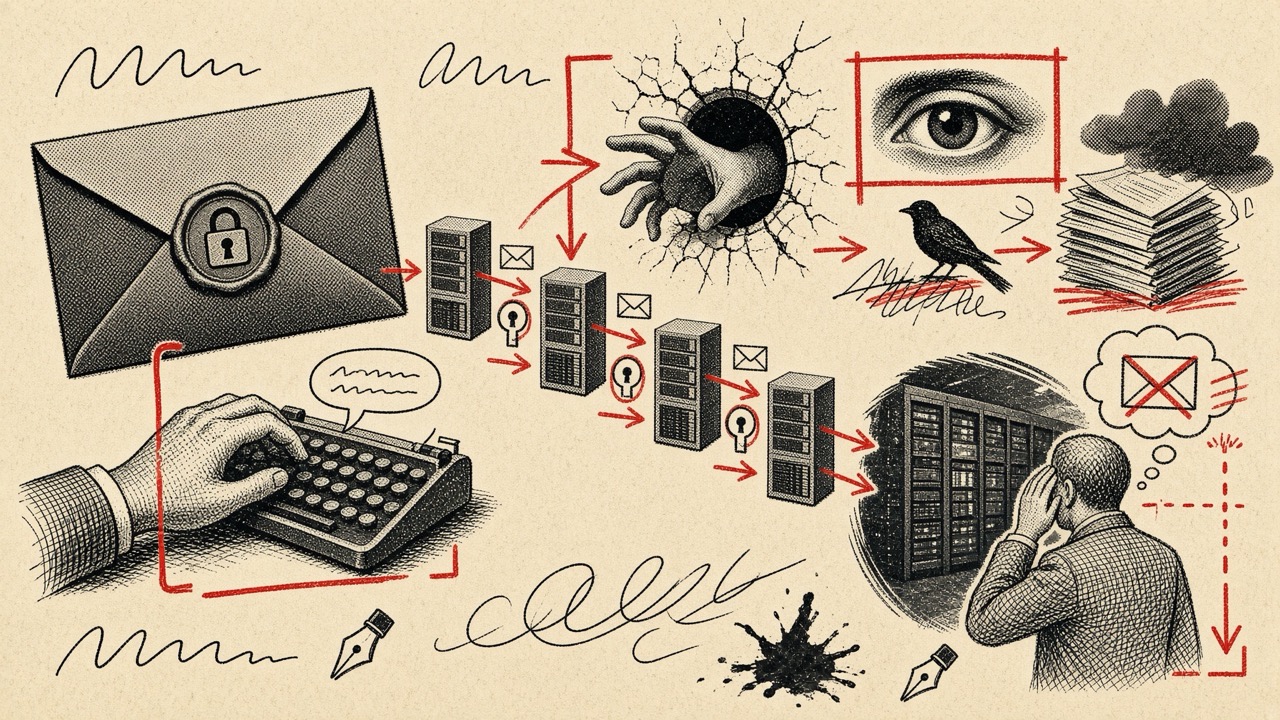
To see why bait was needed, follow a single prompt on its journey:
- You type into an app, such as a note-taker, a coding tool or a chatbot.
- The app often passes your words to an AI “router,” a middleman that shops for the cheapest place to run the request.
- The router hands it to an inference provider, a company that rents out computers to run AI models.
- That provider may be a reseller of a model built by a lab somewhere else, and may pass the request on again.
You see none of these steps. Each one is a company that could keep, read or lose your words.
Three ways the bait leaked, according to Dragos
By Dragos’s account, the bait was taken. It says secrets escaped through three kinds of leak.
| How it leaked | What Dragos says it saw |
|---|---|
| Hackers inside AI providers | At least three hosting providers were breached. In the largest case, attackers copied every request sent during several windows in late October, including some rejected before a model ever ran. Several hundred bait keys turned up in tens of thousands of cloud calls, some tested within hours. None of the three providers knew until Dragos told them. |
| Sellers reading prompts | On one AI marketplace, sellers could see customers’ prompts simply by listing a model at the lowest price and switching on request logging. Someone on a home internet connection in France then tried to log in to servers with passwords taken from two prompts. |
| A lab ignoring privacy settings | An unnamed Chinese AI lab opened the secret links in more than half of the prompts sent to its models, including about two-thirds marked “zero data retention” or “no data collection.” One link, sent to a US provider with that setting on, was opened 24 days later from a chat app, on six devices in Beijing and Shanghai within two minutes. |
The details come from Dragos and from coverage by The Next Web and Dataconomy. Dragos has not named the three breached providers or the lab.
There is an AI twist, too. On November 1, one attacker began using ARTEX, an AI-driven hacking tool, to check whether the stolen keys still worked. And one provider, Together AI, said an AI coding assistant had accidentally published a password to a public code site, letting an outsider download stored prompt samples, Dataconomy reported.
Update: OpenRouter names MiniMax and pulls its privacy labels
Dragos kept its companies anonymous. Two days later, one name surfaced anyway, from someone else.
On November 21, OpenRouter, a popular AI router, emailed some customers under the subject line “Requests you sent to MiniMax models may have been read.” The email, which customers posted on Hacker News and X, warned that “a third party may have read the prompts and outputs of these requests.”
According to the email, a researcher’s test links sent to models from MiniMax, a China-based AI company, were opened 40 to 130 hours after each request. That happened whether the prompts went to MiniMax directly or through three resellers: AtlasCloud, Novita and StreamLake. None of the bait cloud passwords on that route were used, the email said. OpenRouter removed the zero-data-retention label from those MiniMax connections while it investigates.
MiniMax has not made a public statement. OpenRouter says MiniMax told StreamLake that content moderation, an automatic check on messages, was switched on before October 22, and that it has since turned on zero data retention. OpenRouter says it asked MiniMax for its own account and has not received one. Novita said a routing error sent some requests to MiniMax between May 28 and November 11. Dragos has not confirmed that MiniMax is the lab in its report.
On November 22, OpenRouter went further. It removed three providers and stripped 125 of its connections of their zero-data-retention label, while saying its own systems were not breached. Its chief executive, Alex Atallah, said providers’ privacy commitments “have relied mostly on self-attestation” and that this “isn’t sufficient,” Sulat reported. In plain terms, the privacy label often rested on the provider’s own word.
Why “zero data retention” settings didn’t protect the prompts
“Zero data retention” is a promise that a company will process your request and keep nothing. Many AI tools offer it as a setting. So why, by Dragos’s account, did it fail so often?
Part of the answer is simple. “A privacy flag doesn’t help when the attacker is already inside,” Moore told The Next Web on November 23. A hacker copying requests at the front door doesn’t care what the request asked for.
The other part is the chain itself. Dragos argues that a privacy setting only binds the first company in line. After that, the cheapest route decides where your words go. “Zero Data Retention is supposed to mean something,” Moore said.
Notion learned this the hard way. In its notice, the company said “data was retained from the Fireworks endpoints that we used,” despite understanding the data would not be kept. Its customers had no way to see the problem, because they never dealt with Fireworks at all.
And deleting a chat doesn’t undo the damage. As Fireworks itself warned its customers, “removing a stored secret alone does not invalidate the underlying credential.” A password that leaked stays useful until you change it.
How to keep secrets out of AI chats: five habits
You can’t see the chain behind your AI tool. You can control what you put into it.
- Never type a secret into an AI chat. That means passwords, one-time codes, card or bank numbers, and the keys that unlock software accounts. The Cloud Security Alliance, an industry group, gives this as its first advice after the Fireworks breach.
- If you already did, change it today. Deleting the chat does not cancel the password. Change it at the service it belongs to, as Notion told its affected users.
- Watch for scams that quote your own chats. Notion warned that leaked transcripts could be used for phishing, fake messages that use real details to win your trust. An email that mentions something you only ever told an AI is a red flag.
- Prefer AI tools from the company that built the model. Dragos advises going directly to a first-tier provider, with one contract and one privacy policy, rather than through cheap resellers and marketplaces.
- Treat privacy settings as a bonus, not a guarantee. Switch them on, but write every prompt as if a stranger might one day read it.
The chat box is a doorway, not a diary
The uncomfortable truth is that an AI chat feels like talking to one helper. In reality, it can be a relay race between companies you have never met, each running to the cheapest finish line.
None of them is your diary. So before you type, ask one question: would I be fine if a stranger read this? If the answer is no, don’t hand it to the machine.
Related reading: AI Psychosis: Why the Chat That Feels Most Private Can Be the Riskiest; AI Scams: How They Work and How to Protect Yourself; The CEO on the Call Was Not the CEO.
Ajith M S — Full-time reader, part-time writer, interested in AI and its societal impact. x.com/ajithms · Last reviewed: November 2026 · Drafted with AI assistance and checked by a person before publishing.
Questions readers are asking
Does this mean ChatGPT, Claude or Gemini leaked my chats? Nothing reported so far says so. The companies named in the fallout are smaller AI routers, hosting firms and resellers, plus MiniMax, which OpenRouter named in its customer email. Dragos advises using first-tier providers directly, because each middleman adds risk.
I used Notion AI. Was I affected? Notion says fewer than 1% of workspaces were affected and that it has contacted them. If you pasted a password or key into Notion AI, change it anyway.
What is an AI supply chain? It is the line of companies that handle your request between the app you use and the model that answers, such as routers, hosting providers and resellers.
Sources
- HD Moore, Dragos, Three breaches, endless leaks: Your AI supply chain needs canaries, November 19, 2026. The original research: method, the three kinds of leak, attacker behaviour, advice.
- Ana Maria Constantin, The Next Web, OpenRouter drops three AI providers after Dragos catches prompt theft, November 23, 2026. HD Moore quotes, OpenRouter’s response, the Feishu chat detail.
- Dataconomy, Dragos finds breaches at three AI inference providers, November 23, 2026. Marketplace logging, the Together AI incident.
- Cloud Security Alliance, Fireworks AI Breach: Inference Providers as Supply-Chain Chokepoints, November 17, 2026. Fireworks and Notion timeline, company statements, user guidance.
- Notion, Notice about the Fireworks AI incident, November 2026. Fewer than 1% of workspaces affected.
- BleepingComputer, Notion says Fireworks breach exposed customer AI chat transcripts, November 11, 2026. Notion’s disclosure.
- Ars Technica, A leaky AI supply chain is exposing secret user data at an alarming rate, November 2026. The story that prompted this piece, including its November 21 update on OpenRouter’s customer email.
- OpenRouter customer email, as posted on Hacker News, November 21, 2026. MiniMax named; the 40-to-130-hour delay; AtlasCloud, Novita and StreamLake; MiniMax’s account relayed via StreamLake.
- JP Caparas, Sulat AI & Tech News, OpenRouter’s CEO says Zero Data Retention relied mostly on provider self-attestation, November 21, 2026, updated November 23 and 24. Alex Atallah quotes, Novita’s notice, the absence of a MiniMax statement.
Key terms in this article
- Inference provider
- A company that rents out computers to run AI models and return answers.
- Zero data retention
- A promise that a company will process your request without keeping a copy.