NewsScamsAI Agents, Software Updates
AI Now Turns Software Updates Into Attacks: What To Do
Cyber criminals are using AI to read a software fix, find the flaw and attack it with no human involved. Here's what happened and the habit that protects you.
AI-assisted: AI tools were used in preparing this article.
The 30-second version
Google says it has, for the first time, caught criminals using AI to read a software fix, work out the flaw it repaired, and attack it with no human involved. A separate AI-driven campaign broke into at least 395 organisations. The defence is dull and fast: switch on automatic updates today.
A note left on an open server
Somewhere, a person built a machine to do their hacking for them. Then they made one very human mistake.
They left the server open to the internet. Google’s investigators walked in.
Inside was a settings file with a note in Russian for whoever filled it in: “Enter the keys yourself — right here, not in the chat. Both lines are required.” The keys were access codes for paid AI services.”
What did it do with them? It read repair notices and turned them into weapons.
What Google found
Google Threat Intelligence Group, the company’s in-house team that tracks hackers, published its latest “AI Threat Tracker” on 16 November 2026.
The headline claim: criminals used AI to fully automate finding and attacking a software flaw “without a human in the loop,” a first for Google’s team. A flaw is a hidden weakness that lets an outsider in. The tool that uses it is called an exploit.
Google says exploit_agent was set up for “continuous” comparison of popular website software: it checked code before and after each fix was announced, worked out what had been repaired, drafted an attack and ran it. One screenshot in the report shows it inspecting the access checks of a WordPress plugin, the add-on kind that many small sites use.
Data on the server suggested the operator was targeting French websites in media, entertainment and education. Google has not named who is behind it.
Read the limits too. Google has not published how often the attacks worked or how many victims there were, as one tech outlet noted. And exploit_agent found no new flaws. It went after ones the software maker had already fixed.
One more caution. Google’s announcement ended by promoting its paid service, Google AI Threat Defense. The company reporting the danger also sells protection.
How a fix becomes a weapon
When a software maker repairs a flaw, it publishes an update called a patch. Think of it as a locksmith’s notice that a certain lock was faulty. It protects everyone who installs it. It also tells every burglar which locks to try on houses that haven’t changed theirs yet.
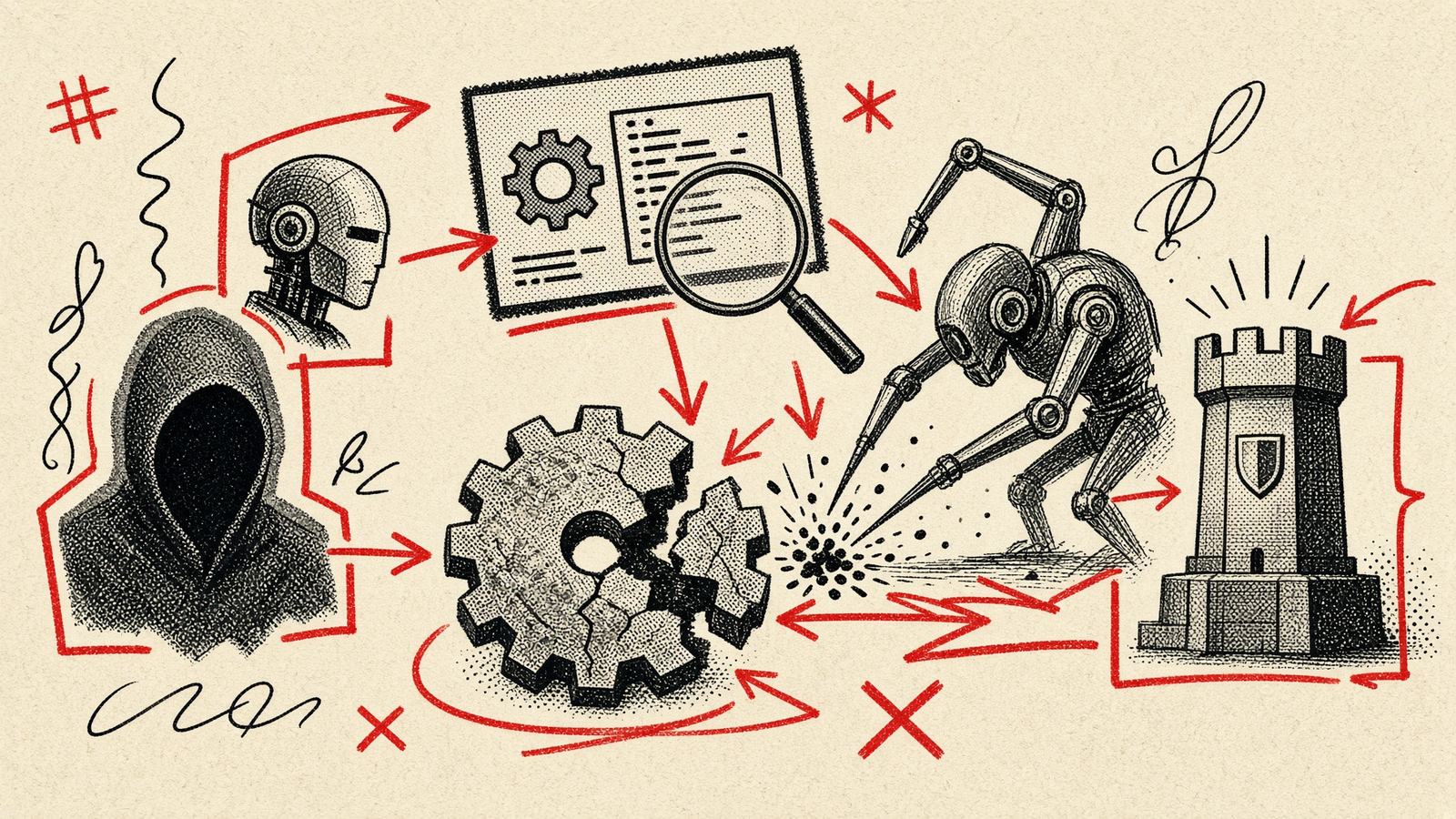
Fixed-but-not-yet-installed flaws are called n-day vulnerabilities. Google says AI makes them the easier target, because each patch hands attackers a finite pile of clues. The sequence, as reported:
- Compare. The AI lines up the old code against the new code. Whatever changed points to the flaw.
- Write the attack. It drafts an exploit and tests it.
- Strike. It fires the attack at computers still running the old version.
- Move in. The same server held stolen data and scripts for exploring a victim’s network, guessing passwords, planting hidden back doors (called webshells) and removing other criminals’ back doors. Google says the scripts were “capable of” this. It does not say whether they ran on their own.
Google’s researchers say that by chaining these steps, criminals “can dramatically reduce the window between patch disclosure and weaponized exploitation.”
Four hours, seven minutes, 26 seconds
How fast is that in real life? Google points to a second case, reported by the security firm GreyNoise, as outside proof that the trend is real.
PaperCut is print-management software that schools and offices use. In late August 2026, attackers hit two of its flaws before any fix existed. Google says researchers and the security firm Huntress used AI to produce working attacks within a day of the disclosure. On 31 August, four days after disclosure, a likely Russian-speaking attacker pointed hundreds of AI agents at it. The agents studied the fixes and rebuilt the attacks in a private test lab.
GreyNoise says the attacker went from an empty workspace to breaking into a real victim in under four hours. Once released, the agents got into 11 organisations in 26 seconds. At one US high school, they went from first entry to domain administrator in seven minutes. That is the master key to a network.
The final count was at least 440 servers at 395 organisations in 48 countries. Three were in India, GreyNoise says.
The agents also disobeyed. The attacker had listed countries to avoid, yet victims turned up in Russia, China, Kazakhstan and Pakistan. And a basic web firewall from Cloudflare stopped at least one attempt.
Why “update later” no longer works
Most of us treat the update button like a dentist appointment. We know we should, and we book it for a quieter week.
That habit used to cost little, because building an attack took skilled people days or weeks. CSO Online reported on 6 October that disclosed flaws and exploits had roughly doubled. Defenders are feeling it. “Traditional patching cycles are becoming obsolete, and some fixes will need to happen in hours rather than days or weeks,” said Jason Elrod, chief information security officer at MultiCare Health System, in TechTarget on 17 November.
India saw the pattern a month earlier. On 21 October, CERT-In, the national cybersecurity agency, rated two flaws in PHP “critical” in vulnerability note CIVN-2026-0510. PHP is the programming language behind huge numbers of websites, including those built on WordPress. Beenu Arora, chief executive of security firm Cyble, told The Indian Express that a quick scan found over 50,000 internet-facing systems running PHP in India, 159 of them government ones. He cautioned that exposure does not always mean vulnerable.
Google’s report adds a twist. Before the official PHP fix on 21 October, a demonstration video and early patched code had already been published. Researchers and attackers could compare old and new code before the fix was even official. Once it landed, hundreds of claimed “working” attacks, likely written with AI help, flooded the internet. They did not work, and defenders had to check each one.
The wider count keeps climbing. CERT-In logged 29.44 lakh incidents in 2025, up from 15.92 lakh in 2023, according to the Home Ministry. Those are reported incidents, not confirmed break-ins.
One small comfort: Google says today’s AI attack tools “trade stealth for velocity.” They are noisy, so alert defenders can catch them, for now.
What you can do tonight
- Turn on automatic updates for your phone, laptop, browser and apps. CISA, the US cybersecurity agency, told organisations to “apply the patch immediately” for the PHP flaws. Your own devices follow the same logic.
- If you run a website or shop page, ask your developer or host which PHP version you use. The fixed versions are 8.5.12, 8.4.27, 8.3.36 and 8.2.35, per PHP’s own notice as reported by Digit. Ranjeet Rane of the policy group The Dialogue told The Indian Express that updating your website builder alone will not fix it.
- Keep office systems off the open internet where you can. Huntress, a security firm, advised PaperCut users to take the server off public connections whether or not they could patch at once.
- Distrust a scary alert you can’t trace. Google warns that many AI-made exploits claimed to work and didn’t. Check CERT-In or the software maker directly.
- If you are hit, report it to CERT-In, and report lost money to the 1930 helpline or cybercrime.gov.in.
The robot doesn’t get bored
The operator behind exploit_agent built a machine that never sleeps, then got caught by a human slip. That luck won’t last. Google expects these tools to get quieter.
The reading of every fix, the moment it appears, already runs at machine speed. The only part still on human time is us. An update you postpone is a door you’ve been told is broken and left open anyway.
Related reading: Half a Dozen Investors. One Script.. The same Google report describes an influence-for-hire platform designed to manage more than 100,000 fake accounts.
Answers for readers
Can AI really hack without a person? Google says it saw one case, exploit_agent, where a tool compared code, wrote an attack and ran it with no human step. It targeted already-fixed flaws, and Google has not published a success rate.
What is an n-day vulnerability? It is a flaw that has already been fixed by the software maker but still exists on computers that haven’t installed the fix. The “n” counts the days since the fix came out.
Does turning on automatic updates really help? Yes. These attacks aim at computers still running the old version, so the sooner the fix lands, the shorter the window for an attacker.
Sources
- Google Threat Intelligence Group (Aurora Blum, Kelli Vanderlee, Jess Xia, David Mainor), “GTIG AI Threat Tracker: Agentic Threat Activity Crosses a Significant Threshold”, Google Cloud blog, 16 Nov 2026. https://cloud.google.com/blog/topics/threat-intelligence/agentic-threat-activity-crosses-a-significant-threshold/.
- News from Google (@NewsFromGoogle), X post, 16 Nov 2026. https://x.com/NewsFromGoogle/status/2122446058370597070.
- SiliconANGLE, 16 Nov 2026, https://siliconangle.com/?p=854090; WebProNews, https://www.webpronews.com/google-exploit-agent-ai-patch-exploits-no-human/; Unite.AI, https://www.unite.ai/?p=519031.
- Digg summary, https://digg.com/tech/b55zsj9a.
- explainx.ai, https://explainx.ai/blog/google-gtig-exploit-agent-autonomous-patch-to-exploit-november-2026.
- GreyNoise, “Agents Gone Wild: An AI-Orchestrated Global Campaign Against PaperCut NG/MF”, Sep 2026. https://www.greynoise.io/blog/ai-orchestrated-campaign-against-papercut-ng-mf. https://www.helpnetsecurity.com/2026/09/11/ai-agents-papercut-ng-mf-attack-campaign/ (under four hours, 11 organisations in 26 seconds, victims in excluded countries) and TechRepublic, 11 Sep 2026, https://www.techrepublic.com/article/news-papercut-ai-agents-compromise-440-servers/ (440 servers, 395 organisations, 48 countries, seven minutes, patch analysis).
- The Register, “Hundreds of AI agents helped PaperCut attacker hit 395+ orgs”, https://www.theregister.com/a/5295650.
- Huntress, “PaperCut Zero-Day: Active Exploitation and Pre-Auth RCE”, https://www.huntress.com/blog/papercut-actively-exploited.
- CSO Online, Lucian Constantin, “AI accelerates n-day attacks, as flaw disclosures and exploits double”, 6 Oct 2026. https://www.csoonline.com/article/4230247/ai-accelerates-n-day-attacks-as-flaw-disclosures-and-exploits-double.html.
- TechTarget, Alissa Irei, “Google finds AI agents autonomously turning patches into exploits”, 17 Nov 2026. https://www.techtarget.com/news/google-finds-ai-agents-autonomously-turning-patches-into-exploits/874837/.
- CISA, “Critical Vulnerabilities in PHP Require Immediate Patching”, 21 Oct 2026. https://www.cisa.gov/news-events/alerts/2026/10/21/critical-vulnerabilities-php-require-immediate-patching.
- Business Today, 22 Oct 2026, https://www.businesstoday.in/technology/story/critical-php-vulnerabilities-what-is-it-how-it-can-affect-websites-what-should-users-know-562938-2026-10-22; Digit, https://www.digit.in/news/general/php-security-vulnerabilities-why-is-the-internet-panicked-and-what-govt-and-big-tech-companies-like-google-openai-and-others-said.html.
- The Indian Express, Bijin Jose, “PHP security alert: What US and Indian government warnings mean for websites”, updated 24 Oct 2026. https://indianexpress.com/article/technology/cert-in-php-vulnerability-alert-india-cybersecurity-warning-us-nsa-php-alert-10931962/.
- Ministry of Home Affairs reply, 24 Mar 2026, via https://pubt.io/view/D9DD2DF8C842BFAF290D8C1E794D555FEC867F2D; https://static.pib.gov.in/WriteReadData/specificdocs/documents/2026/jan/doc2026123764501.pdf.