NewsScamsInvestment fraud
Half a Dozen Investors. One Script.
Scammers used AI to script a WhatsApp group of fake investors. A retiree from India lost ₹3.4 crore to a group like it. Here is how to spot one.
AI-assisted: AI tools were used in preparing this article.
The 30-second version
Can a WhatsApp group full of happy investors be fake? Yes. In October 2025, OpenAI reported that scammers used ChatGPT to script a whole investor chat, expert included. In Chennai, a 69-year-old retired bank employee sent ₹3.4 crore to a group police say showed fabricated profits. Never pay because a group says so; if you have, call 1930.
You are added to a group where everyone is winning
A WhatsApp message arrives from a man who calls himself Rajiv Mehta. He says he is the chief investment officer of a Bengaluru firm. Minutes later, you are added to a group.
The group is busy. About 50 members swap tips and post their profits. Nobody seems to lose.
So you ask the obvious question. If all these people are making money, why not you?
That question is exactly what the group was built to plant. Police in Chennai say the profit chats inside it were fake.
A retired banker, 13 transfers and 8,574 accounts
The man who joined that group was a 69-year-old retired bank employee in Chennai. According to The Hindu and The Times of India in October 2026, he was added to a group called “FYERSHNIVIP” and promised high returns.
Believing the chats, he sent about ₹3.4 crore in 13 instalments to accounts in different states. The returns never came and the phone numbers went dead, the reports say. He called the 1930 cybercrime helpline and complained to the Chennai Police Commissioner’s office.
The Cyber Crime Wing arrested Konathala Krishna, 52, in Visakhapatnam district, Andhra Pradesh. Police allege that an account of his received ₹40 lakh of the victim’s money. He has not been convicted and is presumed innocent.
Where did the rest go? Investigators say it passed through 20 layers, 150 banks and 27 payment apps before landing in 8,574 bank accounts. Police have recovered about ₹21 lakh so far. They have not said whether AI was used in this case.
Here is the detail that stings. The victim had spent a career around money. The room still did the convincing.
The same crowd, written in one block
Now look at a case OpenAI investigated itself. In its October 2025 threat report, the company described a scam operation, likely based in Cambodia, that sent bulk text messages to phone numbers in the US. One message reached an OpenAI investigator.
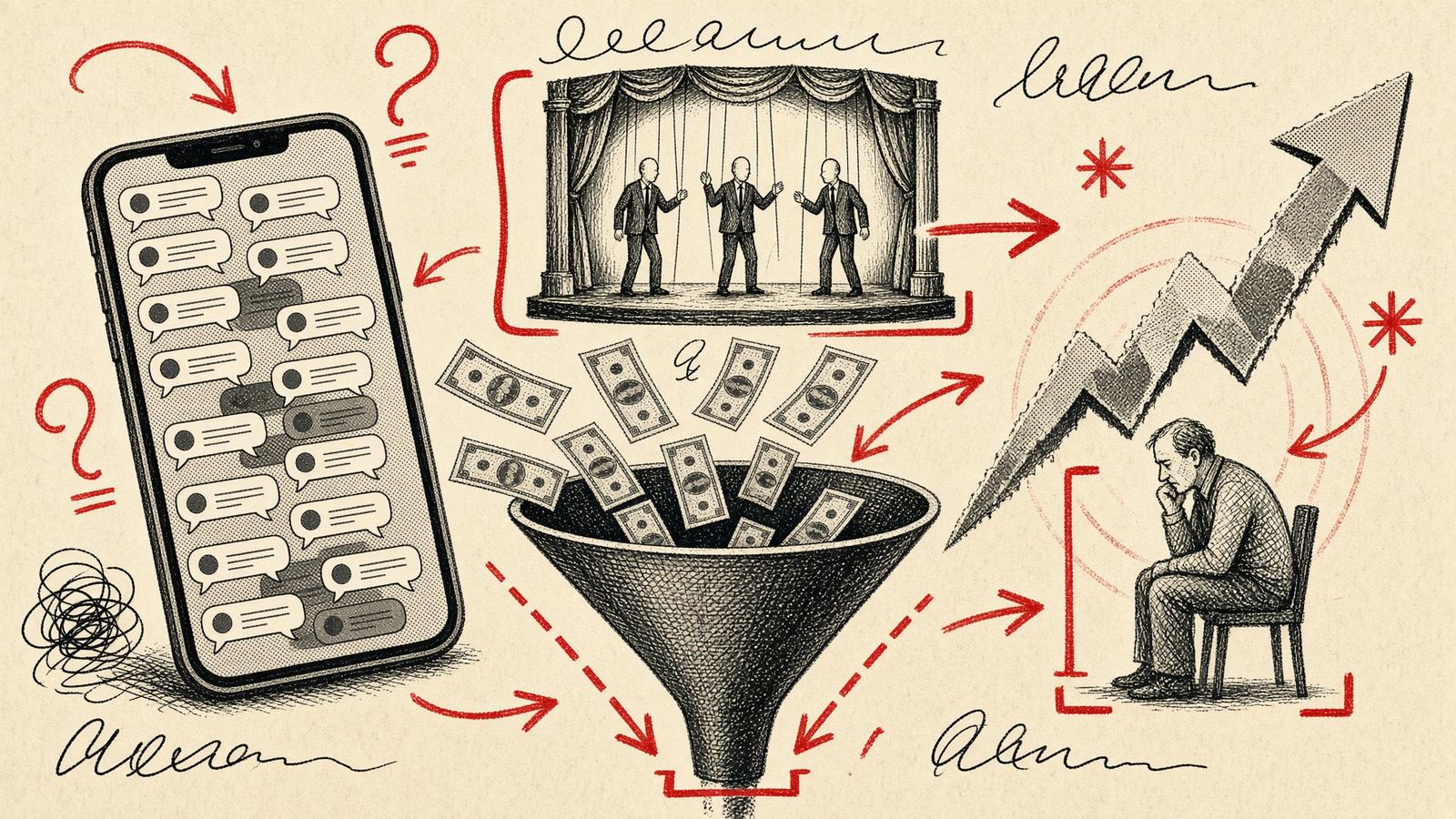
The text invited him into a WhatsApp group named to look like a real investment firm. Inside, he watched what the report calls “a conversation between half a dozen different accounts, all talking about investment.” One account played the expert. The rest played investors, some nervous, some confident.
None of them was a real person talking. OpenAI found that the scammers had generated every line, translated from Chinese in a single block.
The report lays out the scam in five steps:
- The ping. Cold messages and social media ads go out to thousands of people. OpenAI calls this first contact “the ping.”
- The persona. AI writes detailed biographies for fake investment experts and for staff at trading firms that do not exist. A persona is a made-up character with a name, a job and a back story.
- The crowd. A group chat fills with fake investors cheering each other on, so the newcomer feels late to a party.
- The zing. Promises of easy, risk-free profit build excitement. The scammers even pasted victims’ replies into ChatGPT and asked it to keep chatting as the fake character.
- The sting. The victim pays into a fake trading platform. In two Bengaluru cases reported by The Times of India, victims who tried to withdraw were told to pay more in “taxes” and “fees.”
Why a full group chat feels like proof
A crowded room tells us something is safe. A full restaurant beats an empty one. Scammers have always known this, and now they can fill the room for almost nothing. In these schemes, every diner can be hired cast.
On 15 November 2026, a crypto entrepreneur posting on X as Jeremy (@Jeremybtc) wrote that “the internet is filling up with people who don’t exist.” Scams are only one corner of that. OpenAI described a China-origin influence operation, a hidden campaign to sway public opinion, that posted a comment from one account and then replied to it from others. The aim, OpenAI wrote in June 2025, was to create “a false impression of organic engagement.” Even applause can be manufactured.
OpenAI’s investigators say AI has not invented new tricks. Ben Nimmo, principal investigator on OpenAI’s intelligence and investigations team, told reporters in October 2025 that these are “new tools to do the same old job.”
The old warning signs are fading, though. In a December 2024 public alert, the FBI said AI tools “can correct for human errors that might otherwise serve as warning signs of fraud.” The broken English and clumsy grammar we were taught to spot are disappearing.
India is already paying for it. Complaints on the National Cybercrime Reporting Portal rose from 2.6 lakh in 2021 to 24 lakh in 2025, and the money involved jumped from ₹551 crore to ₹22,495 crore, according to a Rajya Sabha reply as reported by India Today.
What to do before the next group adds you
- Never pay because the group says so. The FBI’s advice is plain: do not send money, gift cards or cryptocurrency to people you have met only online.
- Check the “expert” outside the chat. Safety advice The Times of India printed with a Bengaluru case says to confirm that any broker is registered with SEBI, India’s market regulator, and to download trading apps only from official app stores.
- Treat profit screenshots as props. The same advice warns against trusting screenshots and testimonials from strangers. OpenAI’s case shows a whole crowd can be scripted.
- Never pay to withdraw your own money. Demands for “taxes” or “processing fees” before a withdrawal are a warning sign. Victims in two Bengaluru cases reported by The Times of India were told to deposit more before they could withdraw.
- Act fast if you have paid. Chennai’s Cyber Crime Wing urges victims to call 1930 or report at cybercrime.gov.in. In the Chennai case, police froze the receiving accounts and recovered about ₹21 lakh.
The crowd is cheap now
The tools to build that room get cheaper every month. You cannot always tell who is real. But you can always refuse to pay a stranger, however many people seem to be cheering.
A retired banker trusted a room full of strangers, and the room did the convincing. A crowd you can’t check is not proof. It’s a stage.
Three quick questions
- Can AI really fill a WhatsApp group with fake investors? OpenAI says it happened. In its October 2025 report, an investigator was invited into a group where every message was generated by the scammers. In the Chennai case, police have not said whether AI was used.
- How do I check whether an investment adviser is real in India? Look for SEBI registration, the regulator’s own approval, and check it outside the chat. Download trading apps only from official app stores.
- I already sent money. What now? Call 1930 or report at cybercrime.gov.in as soon as you can. In the Chennai case, police froze the receiving accounts and recovered about ₹21 lakh.
Sources
- OpenAI, “Scam operations: Online fraud networks”, 1 Oct 2025, https://openai.com/index/disrupting-malicious-uses-of-ai-scam-operations/.
- OpenAI, “Operation ‘Sneer Review’: China-origin influence activity”, 1 Jun 2025, https://openai.com/index/disrupting-malicious-uses-of-ai-sneer-review/.
- Scripps News, Maura Barrett, “‘Evolution, not revolution’: OpenAI tracks growing misuse of AI by scammers and state actors”, Oct 2025, https://www.scrippsnews.com/science-and-tech/evolution-not-revolution-openai-tracks-growing-misuse-of-ai-by-scammers-and-state-actors.
- FBI Internet Crime Complaint Center, PSA I-120324-PSA, 3 Dec 2024, https://www.ic3.gov/PSA/2024/PSA241203.
- The Hindu Bureau, “Key accused in ₹3.4-crore investment fraud arrested in Andhra Pradesh”, 11 Oct 2026, https://www.thehindu.com/news/cities/chennai/key-accused-in-34-crore-investment-fraud-arrested-in-andhra-pradesh/article71569024.ece.
- The Times of India (TNN), “Rs 3.4 crore fraud trail leads police to 8,574 bank accounts, one arrested”, 10 Oct 2026, https://timesofindia.indiatimes.com/city/chennai/rs-3-4-crore-fraud-trail-leads-police-to-8574-bank-accounts-one-arrested/articleshow/134857362.cms.
- DT Next, “Rs 3.4 crore online investment scam – prime suspect arrested in Andhra Pradesh”, Oct 2026, https://www.dtnext.in/news/tamilnadu/rs-34-crore-online-investment-scam-prime-suspect-arrested-in-andhra-pradesh.
- The Times of India, “Professor, 65, falls for fake stock trading apps, loses Rs 1.2cr”, Nov 2026, https://timesofindia.indiatimes.com/city/bengaluru/professor-65-falls-for-fake-stock-trading-apps-loses-rs-1-2cr/articleshow/135642324.cms.
- The Times of India, “Lured by quick profits, Bengaluru man loses Rs 1.1 crore to stock-trading scammers”, 2026, https://timesofindia.indiatimes.com/city/bengaluru/lured-by-quick-profits-bengaluru-man-loses-rs-1-1-crore-to-stock-trading-scammers/articleshow/135374330.cms.
- India Today, Prateek Sachan, “In numbers: How massive is India’s digital fraud problem?”, 17 Jun 2026, https://www.indiatoday.in/diu/story/cyber-fraud-india-losses-rs-22495-crore-complaints-24-lakh-2025-2928548-2026-06-17.
Key terms in this article
- Persona
- a made-up character, with a name, job and back story, that a scammer pretends to be.
- Influence operation
- a hidden campaign that uses fake accounts to sway public opinion.
- SEBI
- the Securities and Exchange Board of India, the regulator that registers genuine brokers and investment advisers.
- 1930
- India's national cybercrime helpline for reporting online financial fraud.