NewsScamsPhishing
TheMailer: The AI Scam Email That Rewrites Itself
A criminal phishing kit called TheMailer uses AI chatbots to rewrite scam emails until they dodge spam filters. Here is how it works and how to stay safe.
AI-assisted: AI tools were used in preparing this article.
The Scam Email That Rewrites Itself Until It Reaches You
The 30-second version
TheMailer is a phishing kit sold to criminals since March 2026 that plugs into mainstream AI chatbots. It writes scam emails, tests whether they land in spam, and has the AI rewrite them until they reach the inbox. Your defence: never use the email’s own link. Open the app or website yourself.
The email in front of you is the one that won
It is a quiet Tuesday evening. An email from your trading app sits at the top of your inbox. The subject line reads “Unusual activity.”
The logo is right. The grammar is clean. There is not a single typo to save you.
What you cannot see is the version that came before it. And the one before that.
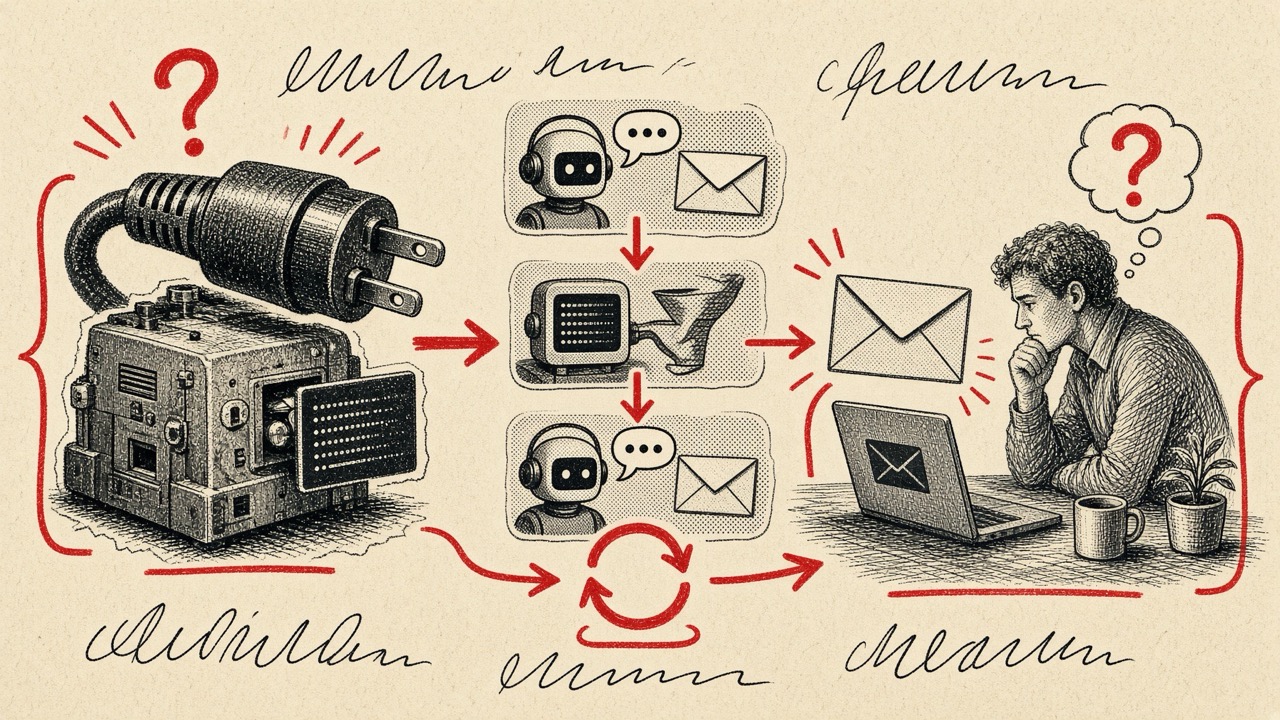
An earlier draft landed in a test mailbox’s spam folder. So a piece of software asked an AI chatbot to rewrite it, sent it again and checked again. It kept looping until a version got through. The email you are reading is simply the survivor.
This scene is a reconstruction, but each part comes from real evidence. Researchers at the security company Varonis found a lookalike Robinhood email with that exact subject line inside a criminal tool called TheMailer.
A $3,000 shortcut, with free installation
TheMailer is a phishing kit: ready-made software that lets a criminal run a fake-email campaign without building anything. Varonis Threat Labs, the company’s research team, described it in a November 2026 report by senior security researcher Daniel Kelley.
The seller has advertised it on a cybercrime network since March 2026. The sales thread has drawn more than 24,000 views. Views are not buyers, but Varonis believes the customer base is large.
The price is $3,000 to $6,000 for a lifetime licence, paid in cryptocurrency through an automated Telegram bot. Installation and support are free. Buyers bring their own mail servers, their own lists of targets and their own proxies, which are borrowed internet connections that hide where traffic really comes from.
No seller has been named or charged. And the AI does not come in the box. Each buyer plugs in an API key, a personal access code that lets software talk to an AI service directly. The kit then works with Claude, ChatGPT, Grok, Gemini, Mistral, DeepSeek and others.
There is no public sign the AI companies knew. Dark Reading, which covered the find, carried no comment from any of them.
Six steps from one sentence to your inbox
Here is what the kit does, in the order Varonis describes it.
- Connect a brain. The criminal links an AI service with an API key. The settings page even suggests routing traffic through home-style proxies, because some AI providers block suspicious addresses.
- Write the bait. The AI produces a polished email, complete with logos and buttons, from a short instruction. It can also copy a real company’s email and turn it into a template.
- Make every copy different. Wording and subject lines are regenerated, so no two people get the same message. Filters that hunt for identical bulk mail have less to match.
- Scrub out the robot. One option strips the patterns that make text read as machine-written.
- Tailor it to your email provider. A module called AI Autopilot sorts targets by provider and adjusts each message for that provider’s filters.
- Fail, rewrite, repeat. The “Inbox Loop” sends a test, checks whether it landed in spam, and has the AI rewrite and resend until it reaches the inbox.
Step six is the turn in this story. Old scam emails were written once and fired. This one learns from every rejection before a human ever sees it.
The extras go further. The kit warms up new sending accounts with fake back-and-forth chats so they look established. It hides links behind real Google web addresses. It creates PDF attachments with your name in the filename, and it can send calendar invites. Another module lets the AI sort and answer the replies.
One list held 145,133 email addresses
The best evidence came from the seller’s own advertising. These are the screenshots and samples Varonis examined.
| What researchers saw | Detail |
|---|---|
| A fake trading-app alert | A Robinhood lookalike with the subject “Unusual activity” |
| A German customer-service email | Sender name “Kundenservice IONOS”, copying a web-hosting company |
| One finished campaign | 24,829 emails sent |
| One target list | 145,133 addresses, almost all Japanese business and university domains |
| Email providers singled out | Gmail, Microsoft, GMX, French internet providers and Yandex |
Other clues point to fake bank, account-security and hotel-booking messages, written in German, French and Russian. How many people actually clicked is unknown. Varonis has not said.
Why “look for the typo” just stopped working
For years, the advice was simple. Scam emails are sloppy, so check the spelling. That rule assumed criminals wrote their own emails. They no longer have to.
A Harvard-led study, published in June 2026 in the journal Expert Systems with Applications, tested this on 101 volunteers. Generic scam emails got 12% of people to click. Emails written entirely by AI got 54%, the same as emails crafted by human experts. The researchers estimated AI can make large phishing campaigns up to 50 times more profitable.
TheMailer is not quite that clever. Kelley told Dark Reading it does not research each victim; the personal touch stops at details like a name on an invoice. He called it “opportunistic phishing with the polish of something targeted.”
That polish is the danger. Varonis says the kit can keep reworking lures “until they bypass spam filters.” Once the filter is beaten, the only checkpoint left is you.
The stakes are already large. The FBI’s 2025 Internet Crime Report, released in April 2026, logged 1,008,597 complaints and $20.877 billion in reported losses. “Phishing [and] spoofing, extortion, and investment schemes were the most frequently reported complaints,” the FBI said. It was also the first year the FBI tracked AI: more than 22,000 complaints and $893 million lost.
Kelley expects copycats. Once one seller offers this, he told Dark Reading, buyers start asking other sellers for it too.
Five habits that beat a flawless email
You cannot out-read a machine that rewrites itself. You can refuse to play its game.
- Never use the email’s own link. Open the app or type the address yourself. TheMailer hides links behind real Google addresses, so a familiar-looking link proves nothing (Varonis).
- Judge the request, not the writing. Varonis now tells companies to train staff to notice urgency, unexpected requests and login prompts, rather than bad grammar.
- Treat “unusual activity” as a reason to slow down. Account-security alerts were among the lures Varonis found. Checking inside the real app takes 30 seconds.
- Your name on an attachment proves nothing. The kit generates PDFs with each person’s name in the filename, plus calendar invites (Varonis).
- Report it. In the United States, file at ic3.gov, the FBI centre whose data produced the figures above. Elsewhere, use your national cybercrime portal.
If you run a business, ask whoever manages your email to switch on SPF, DKIM and DMARC set to “reject”. These are sender checks that stop strangers sending mail that pretends to come from your company. Varonis recommends them; note that Varonis also sells email-security products.
The spam folder is no longer your bodyguard
For twenty years, the spam filter quietly caught most scams before we saw them. TheMailer is built to study that guard and walk around it, one rewrite at a time.
So the email that reaches you may be the best one a machine could produce. It will look right, read right and feel urgent. The defence is not sharper eyes. It is one fixed habit: let the email be perfect, and still go around it.
Ajith M S — Full-time reader, part-time writer, interested in AI and its societal impact. x.com/ajithms · Last reviewed: November 2026
Sources
- Varonis Threat Labs, Daniel Kelley, “Meet TheMailer: The AI Phishing Kit that Rewrites Emails and Taps Top Models”, November 2026 (page undated; date inferred from coverage). Supports: features, price, sales thread views, AI models, screenshots, targets, defensive advice.
- Dark Reading, “‘TheMailer’ Phishing Kit Puts AI in the Driver’s Seat”, November 2026 (byline likely Alexander Culafi). Supports: Kelley interview quotes, spear-phishing distinction, outlook for copycats, absence of AI-company comment.
- VARINDIA, “TheMailer: AI-Powered Phishing Gets Smarter”, 18 November 2026. Supports: timing of the disclosure.
- Heiding, Lermen, Kao, Verdun, Schneier, Vishwanath, “Evaluating Large Language Models’ Ability to Automate Spear Phishing”, Expert Systems with Applications, June 2026. Supports: 101 participants, 12% vs 54% click rates, up to 50x profitability.
- FBI Internet Crime Complaint Center, 2025 Internet Crime Report, released 7 April 2026, as reported by SOCRadar, Techlicious and Security Boulevard. Supports: complaint count, total losses, AI complaints and losses, FBI quote.